
Visual learning for nursing students
Nursing concept map: template and study examples
A nursing concept map is useful when you can explain its connections, not just fill its boxes. Start with the course concepts in the examples below, distinguish observations from interpretations, and check any clinical relationship against your teaching material.
Create a map from my notesWhat is a nursing concept map?
A nursing concept map organizes course ideas as connected concepts. Each arrow needs a specific phrase, so the two ideas and the link form a meaningful sentence. For example, “cell membrane — regulates movement into and out of — cell” conveys more than “cell membrane — related to — cell.”
This guide is for studying course material. A clinical care map has different requirements, including assessment evidence and your program’s approved format. Do not use an automatically generated study map as a patient care plan.
Free nursing concept map template
Use the central box for one course concept. Fill the surrounding boxes with its definition, parts, function, a related concept, source reference and a recall question. Add relationship labels to your arrows; leave unsupported connections out.
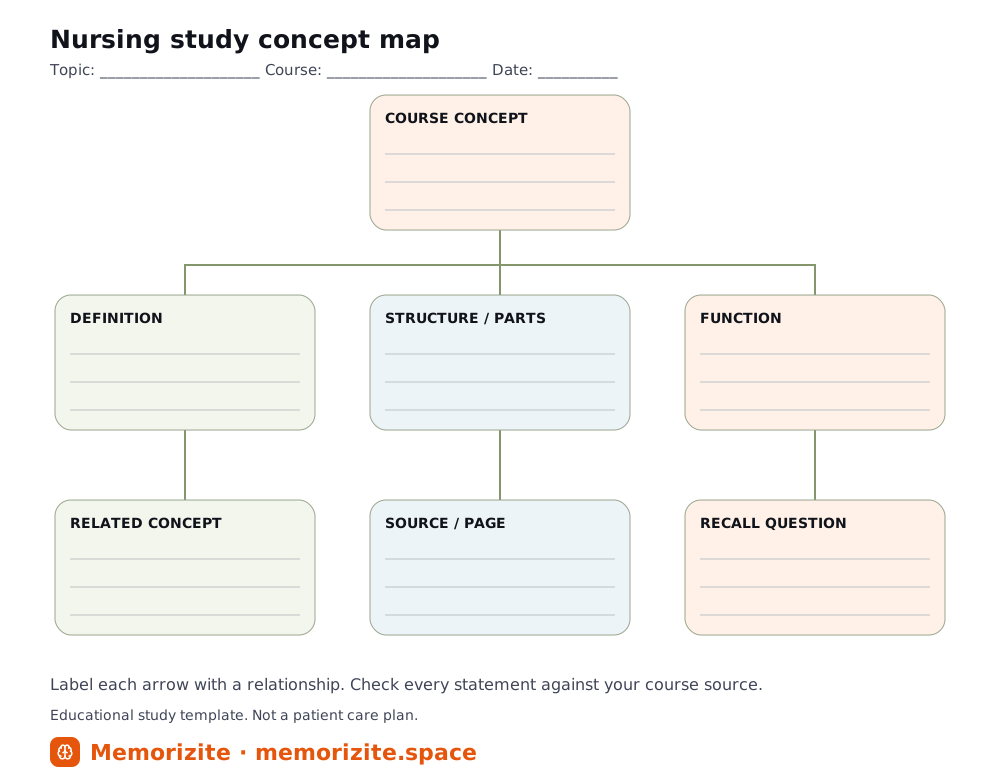
Download the blank template (SVG) · Open the image in a browser and print it in landscape for a paper copy.
The template is a study organizer, not an official school or clinical form. If an assignment specifies another structure, follow that rubric.
Nursing concept map example: cell membranes
This small foundational biology example shows how to write useful links. Verify the wording and level of detail against your assigned nursing course text.
| Concept | Relationship | Connected idea |
|---|---|---|
| Cell membrane | forms the boundary of | Cell |
| Cell membrane | contains | Phospholipid bilayer |
| Membrane proteins | can help transport | Substances across the membrane |
| Selective permeability | helps regulate | Movement into and out of the cell |
Place “cell membrane” at the center, group structure and function separately, and add a question such as “Why does selective permeability matter?” Avoid connecting every node to every other node just to fill the page.
How to make a concept map for nursing
- Choose one learning objective and a short section of your assigned notes.
- Identify the main concept and a few supporting ideas. Keep headings and page numbers as references, not concepts.
- Write one clear relationship per connection. Read each arrow as a sentence.
- Check the map against the source and record where each explanation came from.
- Hide a branch and explain it from memory. Turn uncertain connections into review questions.
Using a pathophysiology concept map
For a pathophysiology assignment, start from the mechanism described in your course source. Separate mechanisms, manifestations and evidence instead of treating them as interchangeable facts. Label whether a connection means causes, contributes to or is associated with, and preserve the conditions and exceptions given in the source.
For a nursing care plan concept map, use your instructor’s approved template and assessment requirements. The blank study template above does not supply diagnoses, interventions or treatment recommendations.
Create and edit a map from your notes
In Memorizite, choose Visualize before uploading your course document. One generation uses one scan. Review the generated concepts, edit card text and relationship labels, move cards and add a relevant image to a card. Export the full diagram as a PDF when you want a study copy.
An AI draft can miss a qualifier or suggest a weak connection. Compare it with your notes before relying on it. Create flashcards or games from the same source in a separate generation when you want another practice format.
Choose Visualize, upload your document and check the result against your source.
Try Memorizite