
Nursing flashcards
Use nursing flashcards to practise the concepts in your own course notes. Ask yourself to explain the answer before revealing it, and check assessment or priority questions against your teaching material rather than treating them as patient-care instructions.
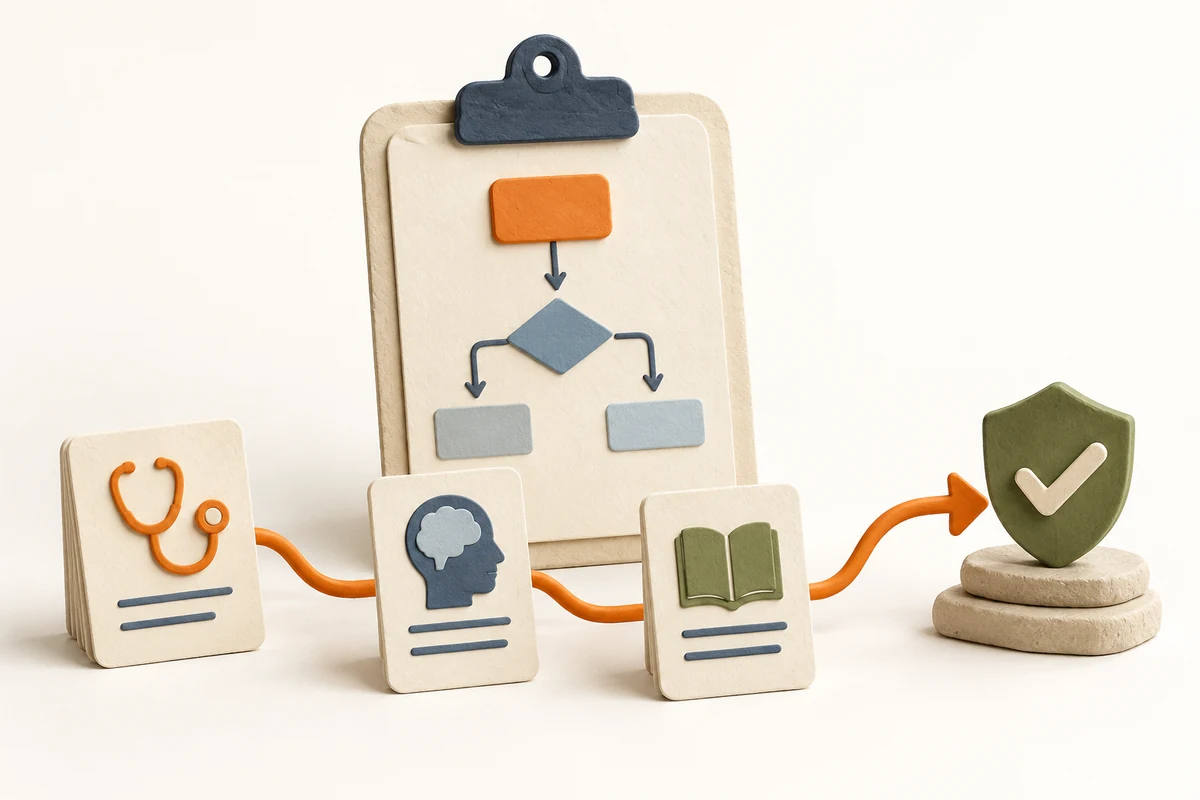
Build nursing flashcards around decisions, not isolated facts
Nursing study often connects an observation, a priority and a reason. Keep those parts visible when you prepare notes. A card asking only for a definition may test vocabulary, while a card asking what information matters next can reveal whether you understand the relationship between concepts.
Start with one lecture objective or a short approved study guide. Preserve headings, conditions and exceptions so generated questions do not lose the context that makes an answer correct. Separate course review from patient care: Memorizite is a study aid and must not be used as a clinical protocol.
Turn a care sequence into three recall tasks
The 2026 NCSBN NCLEX-RN Test Plan describes nursing items as emphasizing application and higher cognitive levels. For your own coursework, convert a process into smaller checks instead of memorizing one long paragraph.
OBSERVE → INTERPRET → CHECK
What should your explanation include after identifying an important observation?
Reveal the study answer
State why the observation matters in the situation described by your source, then name the next check supported by that source.
This is a study-design example, not patient-care advice. Verify every step against your instructor’s material.
Use a three-pass review
- Recall: Answer before revealing the card. Say the relationship in a complete sentence.
- Verify: Compare wording, sequence and qualifiers with your approved source.
- Repair: Rewrite vague prompts and note whether the problem was missing context, confused priorities or a forgotten term.
Reverse the task during the next session: begin with the reason and recall the observation it explains. This helps prevent recognition from feeling like independent recall.
Prepare safe, readable source material
Use text-based PDF, TXT or Markdown files up to 10 MB. Remove identifying patient information and upload only materials you have permission to use. Keep tables with their headings, and split long modules into focused files. Check generated facts, values and sequences before studying them.
For terminology, use the medical terminology guide. For structure relationships, use the anatomy guide. Memorizite does not provide a verified clinical database or ready-made nursing deck.
What the app provides
Memorizite turns your document into flashcards and study games. The card-required 7-day trial includes 10 total scans; broader progress features are available on Student and Pro. Document generation currently supports English, French and Arabic.
Begin with one learning objective, inspect the generated deck and keep the original reference open. If an answer could affect real care, do not rely on generated study content.
PDF, TXT or Markdown, up to 10 MB. English, French and Arabic documents. trial account with 10 total scans during a 7-day card-required trial.
Start learningStudy nursing concepts visually
Nursing concept map guide, printable template and worked example
Nursing quiz generator for course-note revision
Move from nursing terminology recall to educational questions from your assigned course notes. Nursing Quiz Generator from Study Notes.
Review the mechanisms behind your course terminology
Use educational notes to practise body-system functions and basic pharmacology concepts.