
Psychology flashcards
Can you tell two related theories apart without seeing the definition? Make psychology flashcards from your lecture notes to practise terms, contrasts and short scenarios, checking that the examples stay within what your course explains.
Keep theories tied to evidence
Psychology flashcards should distinguish a theory, its prediction, the evidence used to test it and the limits of the conclusion. Avoid cards that reduce a complex account to a slogan. Include the population or context when the source makes it relevant.
Compare similar concepts
Use separate prompts for working memory and long-term memory, positive and negative reinforcement, correlation and causation, or reliability and validity. A useful reverse card describes the relationship and asks for the correct concept rather than repeating the same definition.
A research-methods example
One card can ask what random assignment changes in an experiment. Another can describe two measured variables moving together and ask why that result does not establish causation. Preserve confounds, sample limits and operational definitions from the source.
Use examples without diagnosing people
Everyday examples can clarify learning, perception and decision-making, but they should not be used to diagnose a person or predict individual behaviour. Keep clinical terminology attached to the course material and its stated limits.
Check claims and terminology
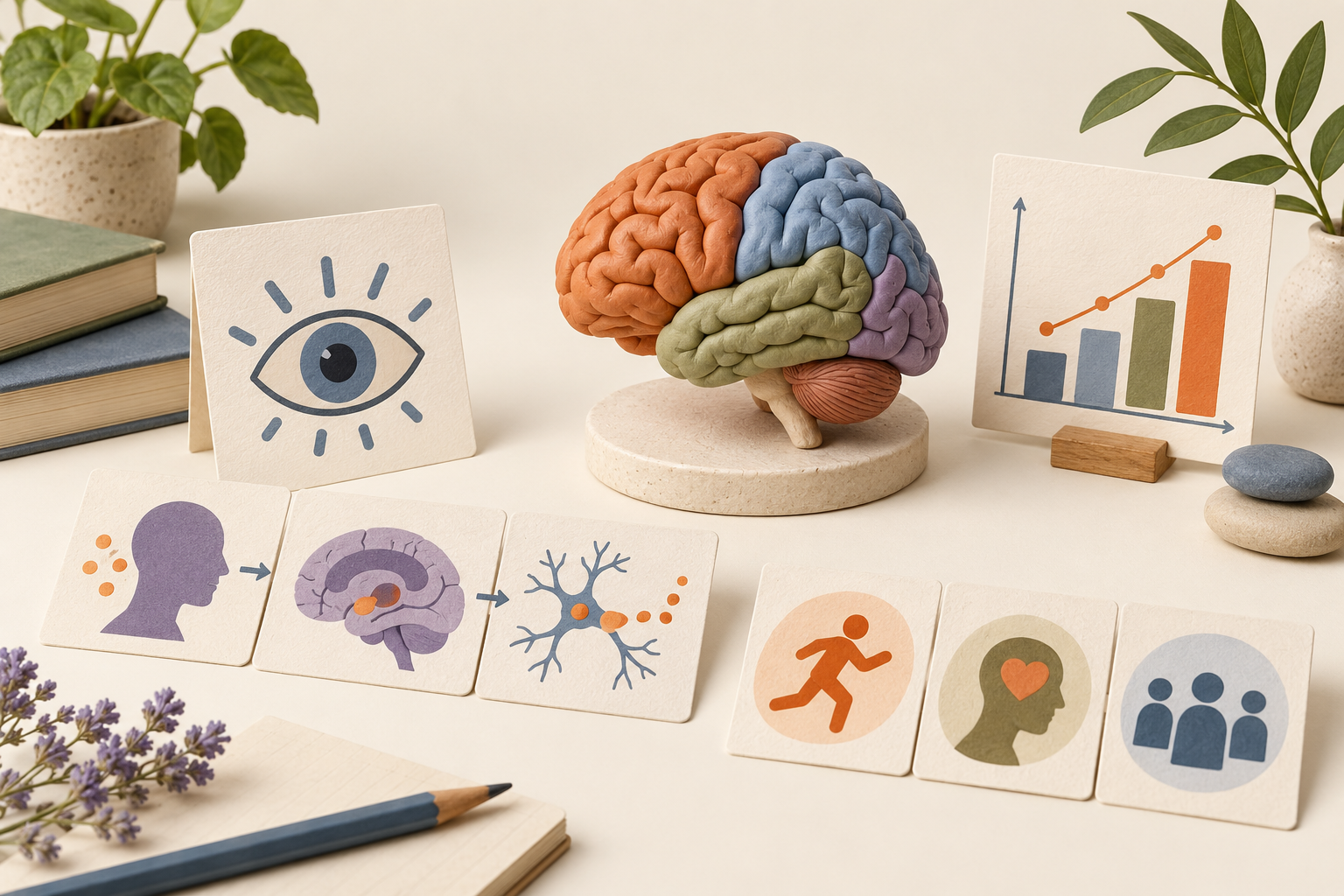
Verify study results, dates, effect directions and definitions against the original source. Generated cards are educational practice, not clinical guidance or a substitute for professional assessment. The illustration is a study cue rather than an anatomical reference.
Choose your next study task
Move from focused recall to a related subject or question-based practice.
Move from definitions to AP Psychology scenarios
Practise distinguishing concepts using original questions and explanations.