
Chemistry flashcards
Use chemistry flashcards to recall the meaning behind a formula or definition. Keep units, charges and reaction conditions in the source, and check the generated cards before using them alongside written problems.
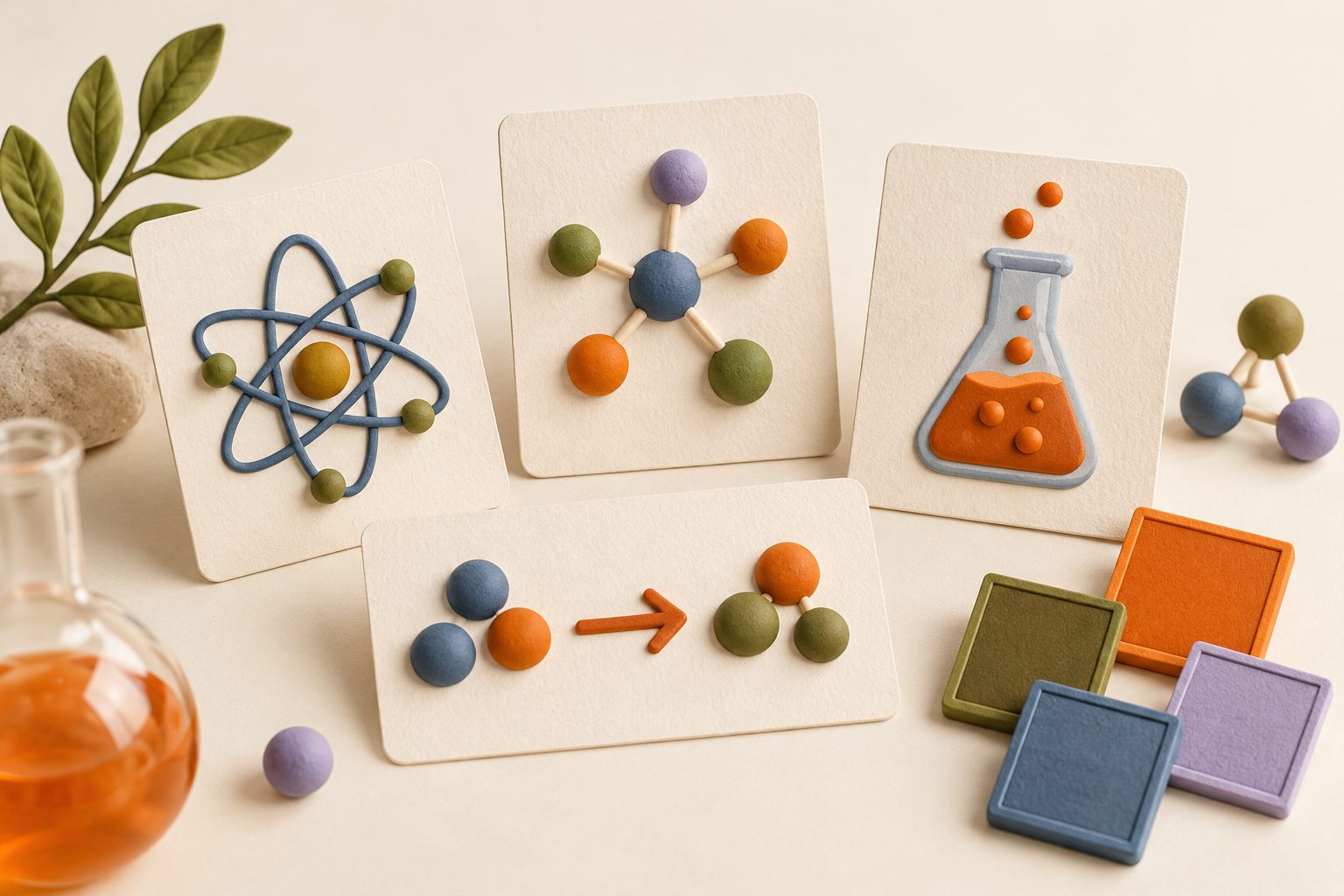
Separate symbols from explanations
A chemistry card should make clear whether it tests a name, formula, unit, particle-level model or conceptual relationship. Keep a symbol beside its meaning in the source, but do not put the answer in the prompt. Preserve charge, state symbols and significant conditions.
Use reactions as more than equations
One prompt can ask for products or reactants, while another asks what evidence supports the reaction type. For mechanisms and multi-step calculations, use several focused cards or an ordering activity instead of compressing the entire solution onto one back.
A bonding example
A card can describe electron sharing and ask for covalent bonding. A reverse card can name covalent bonding and ask what happens to valence electrons. Follow with a contrast against ionic bonding so the learner must discriminate rather than repeat a memorised phrase.
Practise calculations carefully
Keep quantities, units and assumptions visible in the source. Flashcards can test which relationship applies or what each term means, but calculations should still be worked independently. Check rounding, signs and unit conversion against the original example.
Verify technical content
Generated cards may misread subscripts, superscripts, tables or complex notation. Compare every formula and safety-related statement with a trusted source. Memorizite supports revision from your document; it is not a laboratory protocol or chemical safety reference.
Chemistry quiz generator for definitions, units and reasoning
Practise chemistry reasoning and notation with questions grounded in your course notes. Chemistry Quiz Generator from Course Notes.
Revising GCSE chemistry?
Review atomic structure, bonding, reactions and quantities with original examples.
Study organic structures and reaction patterns
Keep functional groups, formulas and conditions together in your course notes.