
Biology flashcards
A biology card can ask for a name, but it can also ask how a process works. Create biology flashcards from one chapter, then compare the answers with your notes and use diagrams to check the relationships.
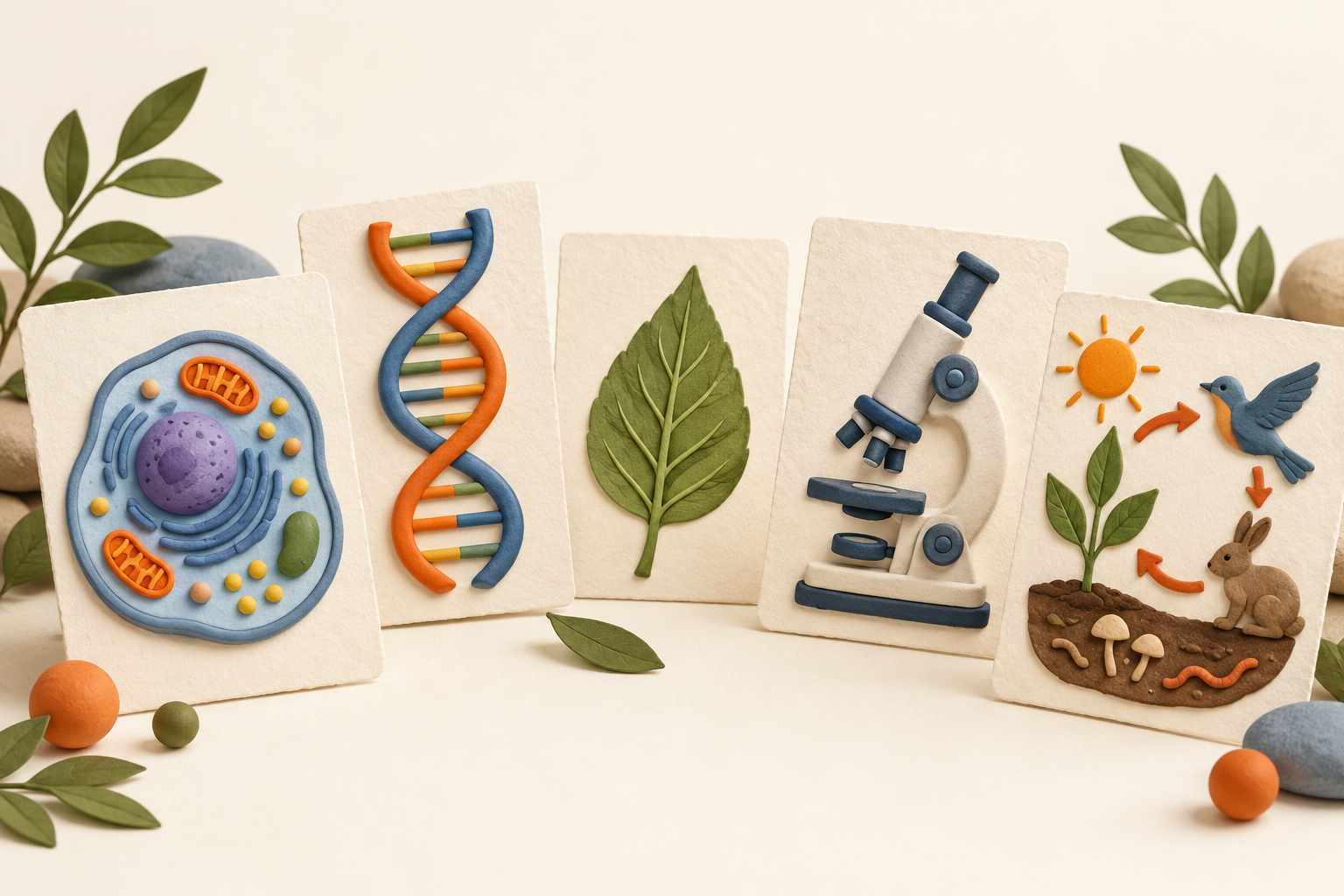
Connect structure with function
Biology becomes easier to retrieve when a structure is paired with what it does and the conditions that affect it. Instead of one card listing every organelle, use focused prompts for membrane transport, energy conversion, genetic information and protein synthesis.
Use processes as relationships
For photosynthesis, respiration, mitosis or transcription, preserve inputs, transformations and outputs. A reverse card can ask which process matches a described outcome. Ordering games are better than a single oversized card when sequence is essential.
A genetics example
One card can ask how a gene relates to DNA; another can describe a segment that contributes information for a product and ask for the term. Keep allele, genotype and phenotype separate, and include conditions when the source says a relationship is not deterministic.
Study ecology across levels
Separate organism, population, community and ecosystem. Use source-supported examples for energy flow, matter cycling and interactions. Avoid turning “is related to” into a causal claim when the notes show only an association.
Check scientific accuracy
Verify terminology, direction, units and exceptions against the course source. Illustrations on this page are decorative study cues, not reference diagrams. Generated cards are revision aids and do not replace laboratory instructions, medical advice or an official syllabus.
Biology quiz generator for concepts and processes
After reviewing biology terms, test your understanding of processes with questions from the same course material. Biology Quiz Generator from Your Notes.
Choose the level of biology practice
Use GCSE, A-Level or AP examples to plan the detail of your own cards.
Focus on a biology topic
Use a focused lesson for structures, inheritance or microbial concepts.